Why medical records need to be digitalized: safety, speed and security
Paper charts are slow, error-prone and impossible to audit. The four pillars driving the digitalization mandate — accuracy, speed, security and workflow.
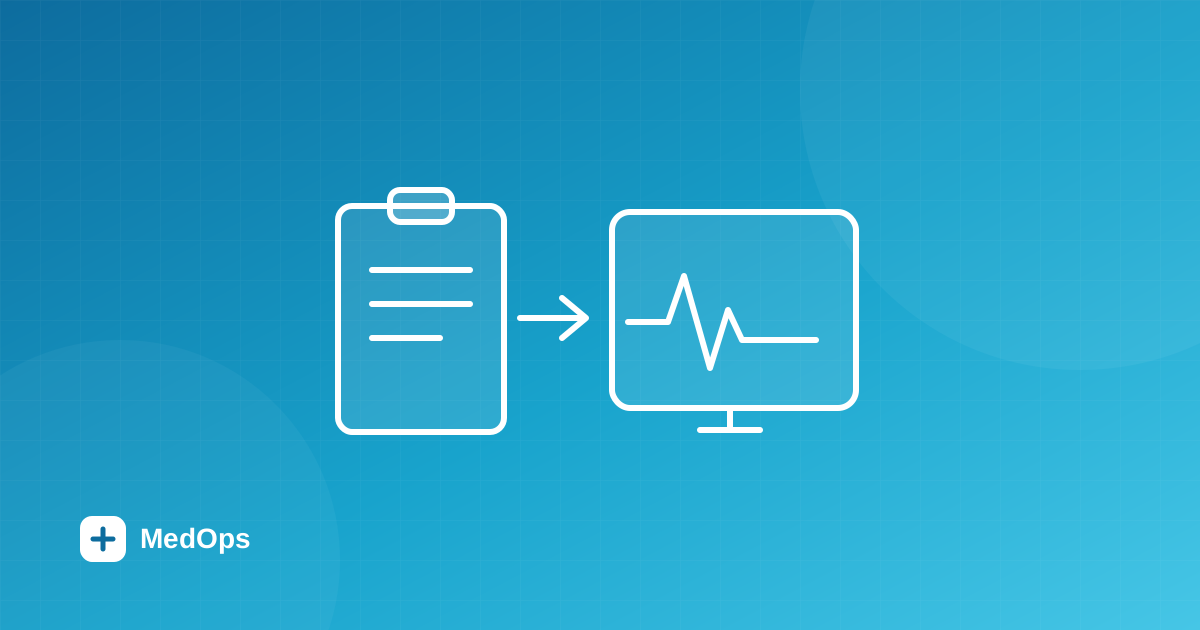
For decades, healthcare delivery relied on physical paper folders, handwritten bedside charts and local storage vaults. In an era of rapid diagnostics and complex clinical coordination, paper-based systems are no longer just inefficient — they are a direct risk to patient safety and operational integrity.
Digitizing medical records through Electronic Health Record (EHR) frameworks is a prerequisite for modern care. Below we examine the four pillars driving the digitalization mandate: clinical accuracy, operational speed, data security and regulatory resilience.
1. Patient safety and clinical accuracy
Paper records are highly susceptible to legibility errors. Ambiguous handwriting on prescriptions or bedside charts frequently leads to incorrect dosing or misidentified conclusions. Digital records make inputs standardized, clear and searchable.
A digital environment also enables automated safety checks. The system can cross-reference new orders against a patient's history at the point of care, so clinicians are prompted before a problem reaches the patient — rather than after.
Handwritten chart errors and fragmented histories cause thousands of preventable complications every year. Structured records solve this at the point of care.
2. Speed of access and coordination
In critical care, seconds matter. Retrieving physical folders from a central archive is slow, especially when a patient is in a different ward or branch. Digital records synchronize in real time: a patient's vitals, previous charts and history are instantly available to any authorized clinician across the hospital network.
Standardizing around interoperability protocols such as HL7 FHIR means patient data can move securely with the patient between providers, eliminating redundant tests and diagnostic delays.
3. Security, accountability and disaster recovery
Physical charts have no audit trail — there is no record of who pulled a file or read sensitive Personal Health Information (PHI). Digital platforms like MedOps keep a tenant-scoped audit log: significant actions are recorded with the actor, timestamp, request path and source IP.
Physical vaults also offer no defense against fire or water damage. Digital records are encrypted in transit, protected by AES-256 encrypted sessions and capability-based access control, and can be backed up to resilient cloud infrastructure — keeping records available even in an emergency.
4. Optimizing workflows and pharmacy logistics
Digitalization links clinical decisions directly to operational logistics. When a doctor completes a consultation in MedOps, the prescription and the consultation-fee bill are generated together in a single transaction, and the prescription is available to the pharmacy counter by number. Stock decrements as it is dispensed, so administrative effort drops and clinicians spend more time on care.
Conclusion
Digitalizing medical records is not simply replacing paper with screens; it is building a resilient, secure and coordinated ecosystem that safeguards privacy and optimizes throughput. In modern medicine, the digital chart is the clinician's most powerful tool.
Want to walk a real consultation-to-bill flow on seeded data? Book a demo — we'll spin one up for your roles.
More from the blog
 Design
The Steel Medical palette: a design language for MedOps HMS
How every color token in the Steel Medical theme was chosen to reflect the precision, trust and humanity of modern healthcare.
 Guide
Guide
What is hospital management software? A complete guide (2026)
What hospital management software actually is, the core modules every HMS needs, the benefits, and a practical checklist for choosing the right system.